
Street food in Italy is becoming increasingly popular, +88.7%
- 01/09/2026
- 0 Comments
- 211 Views
It was on 10 December 2025 that “Italian Cuisine” was inscribed on UNESCO’s Representative List of the Intangible Cultural Heritage of Humanity, during the 20th session of the UNESCO Intergovernmental Committee held in New Delhi, India, recognising its important cultural role as a body of knowledge encompassing not only culinary traditions, but also convivial and social practices passed down from generation to generation throughout the country.
We Italians have always been proud of the great variety and quality of our many regional and local dishes. Our food, just like our history and art, has always been a source of pride when welcoming the many tourists who visit our beautiful country.
In our traditional way of thinking, eating out means sitting at a table and being served by waiters; today, however, we are seeing strong growth in street food.
This trend emerges from a recent study by Unioncamere and InfoCamere, published on 28 August 2026 and based on data from the Italian Business Register updated to 31 March 2026.
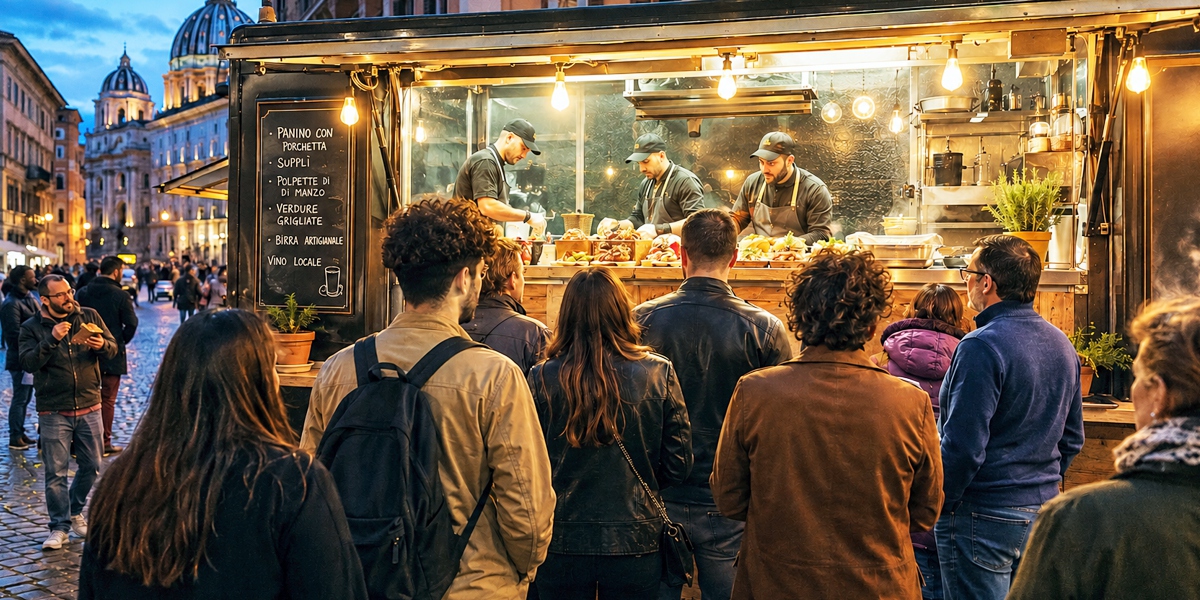
Street food, meaning food prepared and sold from food trucks, kiosks and stalls and served in public places such as streets, squares, markets, fairs and events, has increased by 88.7% over the past ten years. This is the growth recorded in the number of registered businesses operating in activities related to street food, which have almost doubled from 2,271 to 4,286.
Examples of street food in Italy, designed to be eaten quickly and often without sitting at a table, include piadina, arancini, panzerotti, porchetta, pizza by the slice, focaccia, mixed fried seafood, lampredotto and arrosticini. Increasingly common among them is also kebab, which certainly does not belong to the traditional Italian culinary heritage.
Ten years ago, street food was mainly an urban phenomenon, concentrated in large cities and well-established tourist destinations; today, more than one in four Italian municipalities hosts at least one business operating in the sector, compared with just over one in six ten years ago.
Southern Italy accounts for almost half of all registered businesses, highlighting the link between street food and the growing appeal of tourist destinations. The following table shows the figures by macro-area.
| Area | 31-Mar-2016 | 31-Mar-2026 | Absolute change | Change % |
|---|---|---|---|---|
| North-West | 498 | 882 | 384 | 77.1% |
| North-East | 372 | 683 | 311 | 83.6% |
| Central Italy | 445 | 747 | 302 | 67.9% |
| South and Islands | 956 | 1,974 | 1,018 | 106.5% |
| Italy | 2,271 | 4,286 | 2,015 | 88.7% |
Source: InfoCamere-Unioncamere, Movimprese
At municipal level, the highest concentration of street food businesses is found in Rome, with 129 businesses, almost in line with Milan, which has 128. They are followed at some distance by Turin with 78, Palermo with 48 and Bari with 44.
Another equally interesting point is that the phenomenon is no longer limited to large cities: the number of Italian municipalities hosting at least one business related to street food has risen from 1,258 in 2016 to 1,975 in 2026, an increase of 57%. Street food is therefore becoming increasingly common in smaller towns, historic villages and tourist destinations as well.
Finally, another figure worth highlighting, which may be overlooked at first glance in the Unioncamere and InfoCamere report, is the increase in limited companies operating in the sector, which rose from 105 to 620 in ten years. This indicates that street food is no longer confined to small individual or family-run businesses, but is also becoming a sector capable of attracting investment.
These are all figures worth reflecting on, including for our own world of pastry and bakery.
More information is available on the Unioncamere website at the following page: Street food: conquering Italy over the past ten years .